
The Sculptique Aesthetics
Skin Boosters vs Fillers vs Botox: What You Need
A skin booster treats hydration and texture. Filler changes volume. Botox relaxes muscle. babyGLOW here is Teoxane Redensity 1, not a small dose of Botox.
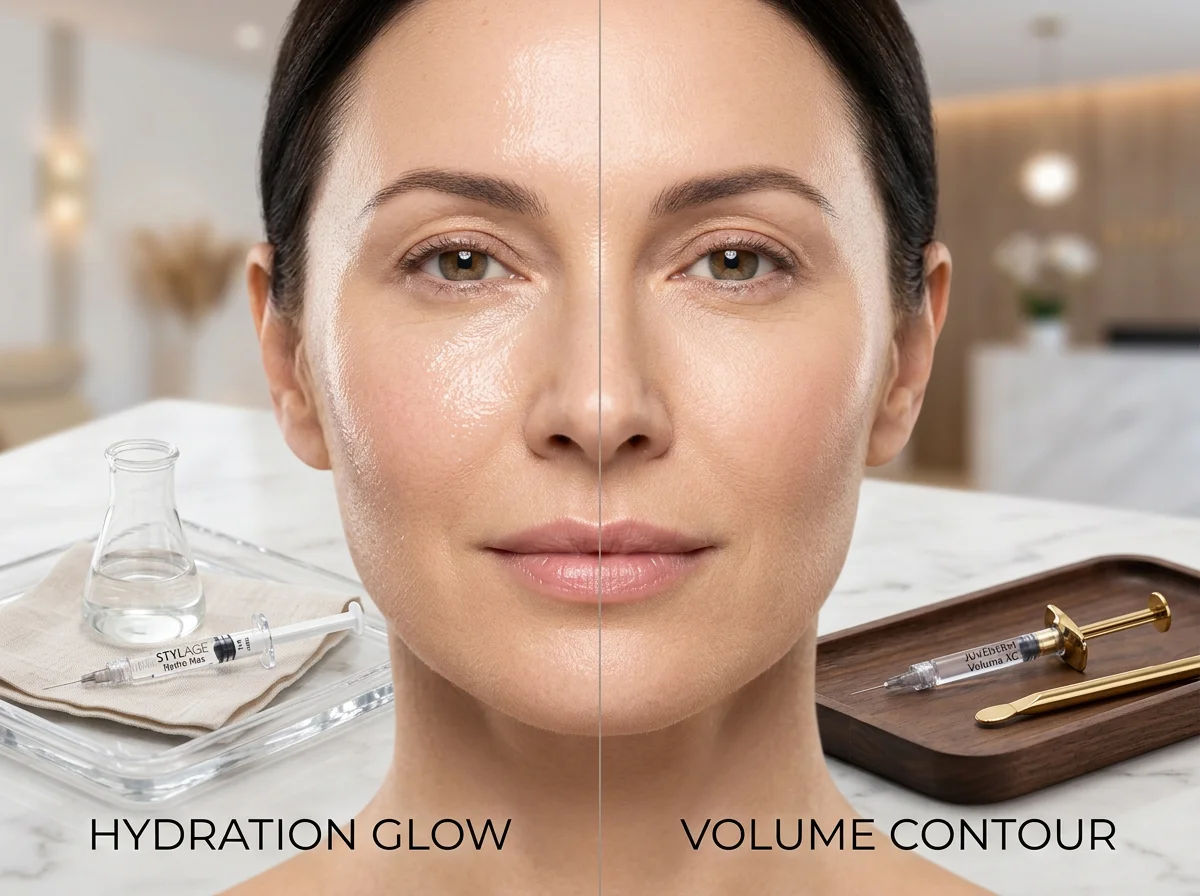
Dull skin, a flat cheek, and a line that appears when you frown are three different complaints. They are often booked as if one injection could answer all of them.
A skin booster is for hydration and texture. A filler is for volume and shape. Botox is for lines made by muscle movement. At The Sculptique Aesthetics, babyGLOW is Teoxane Redensity 1, a hyaluronic acid skin booster. It is not Baby Botox, and it is not a cheek or lip filler.
Three tools, three jobs
Skin boosters are injectable hyaluronic acid preparations placed in small amounts through the skin to improve moisturisation, fine surface lines, and radiance. They are not designed to build a cheek, a lip, or a jawline. Products in this group are not identical. Profhilo and polynucleotides, for example, are a different comparison, covered in polynucleotides and Profhilo. This page is about the choice between a skin-quality injection, a volumising filler, and toxin.
babyGLOW is the clinic name for Teoxane Redensity 1. Teoxane describes that gel as non-cross-linked hyaluronic acid at 15 mg/g, with a dermo-restructuring complex (amino acids, antioxidants, minerals, and vitamin B6) and 0.3% lidocaine. The manufacturer positions it for hydration, elasticity, and fine lines on the face, neck, and décolletage, injected into the dermis, often as a short course and then maintenance. It is a CE-marked device in the materials reviewed. This article does not confirm the current Indian registration of a particular batch. "Baby booster" and "beauty booster" are nicknames you will hear for this kind of skin-quality injection. Ask which syringe is being opened. A nickname is not the product.
Fillers used for contour are typically cross-linked hyaluronic acid gels. Cross-linking makes them stay put and hold shape, so they can support a hollow, a lip, or a fold. That is a different material behaviour from a fluid skin booster, even when both boxes say hyaluronic acid. See dermal fillers for where volume is actually the goal.
Botox is botulinum toxin type A. It does not fill and it does not hydrate. It reduces the pull of the muscle it is placed in, so frown lines, forehead lines, and crow's feet soften while the dose is active. "Baby Botox" usually means a smaller dose of that same toxin, for a lighter effect on lines. It is still toxin. It is not a skin booster, and it will not give you the glow a hydration injection is chosen for. Treatment areas are planned on the Botox page.
What changes in the mirror, and what does not
| Skin booster, including babyGLOW (Redensity 1) | Hyaluronic acid filler | Botulinum toxin | |
|---|---|---|---|
| Main job | Hydration, texture, radiance | Volume and contour | Soften lines caused by movement |
| Where it is placed | Superficial to mid-dermis, spread across an area | Deeper, in a chosen hollow or shape | Into the muscle |
| Face shape | Not the aim | Can change a contour | Can change how a moving area looks, including the jaw if the masseter is treated |
| What you may notice | Smoother, bouncier skin over days to weeks if you respond | A change in shape as swelling settles | A change in expression over the first one to two weeks |
| What it will not do | Lift a jowl, enlarge a lip, or stop a frown | Lighten pigment or stop muscle creasing | Add volume or hydrate crepey skin |
A skin booster will not meaningfully change your face shape. Skin that holds more water can look smoother and a little firmer. It does not relocate fat, sharpen a jaw, or replace a cheek that has lost volume. If someone promises a new contour from a hydration gel, they are describing filler, or they are overselling the booster.
Botox will not moisturise dull skin. Filler will not switch off the muscle that carves a frown when you concentrate. Using all three is sometimes reasonable, in that order of thinking: what is the complaint, then which tool matches it. Using all three because a package says so is how faces end up treated for problems they did not have.
How a product is chosen
The choice starts with the sentence you use.
If you say the skin looks tired, dry, or crepey, and you are happy with your shape, a skin booster is the relevant discussion. Redensity 1 is one option in that group. It is not automatically better than every other hydration injection, and a single brand name does not suit every skin.
If you say a cheek, lip, chin, or groove looks empty, you are describing volume. That is filler, fat transfer, or, when the issue is descent of tissue, surgery. A booster will not fill the groove.
If you say a line is there when you move and fades when the face is still, you are describing muscle. That is toxin. A line that is etched in at rest may need filler, resurfacing, or both, because relaxing the muscle does not always erase a crease that is already carved.
Health decides the rest: pregnancy, a lidocaine allergy (Redensity 1 contains lidocaine), previous reactions, infection, and medicines. The reel cannot see those.
Risks, without pretending the products are twins
Every facial injection can bruise, swell, and hurt for a short time. Infection and allergy are possible.
Skin boosters often leave small bumps for a day or two because the gel sits in the skin. Clinic aftercare for babyGLOW describes redness or bumps settling in about 24 to 48 hours, and a course of more than one visit. That is a usual pattern, not a guarantee you will be unmarked, and not a guarantee of glow. Because these gels are placed more superficially than contouring filler, the early look is different. The risk is not zero. Lidocaine in the product matters if you react to local anaesthetic.
Fillers add the problems of shape: too much volume, a lump, a bluish tint under thin skin, delayed swelling, and, rarely, blockage of a blood vessel. Sudden pain, pale or mottled skin, or a change in vision needs same-day emergency care. Hyaluronic acid filler can be dissolved by a clinician. That is a reason it is widely used, not a reason to treat placement casually.
Toxin adds the problems of muscle weakness you did not want: a heavy brow, an uneven smile, or a look that feels too still. On the labelled facial uses, the effect builds over the first week and lasts on the order of a few months. It cannot be dissolved. Jaw slimming with toxin is a further, separate decision, with its own risk of making jowls more obvious in a lax face.
Do not read a social post that says one of these is "just hydration, so nothing can go wrong." Needles in the face are medical procedures. The rate of serious harm is low in trained hands. The rate is not a marketing zero.
What maintenance actually means
Boosters are often planned as a short series, then occasional top-ups, because the hydration effect fades. Fillers last months, sometimes longer, and should be repeated when the volume has gone, not on a date that ignores swelling you still have. Toxin is repeated when movement returns, commonly around three to four months for the labelled frown treatment, longer or shorter depending on the area, the dose, and you.
Cost follows the product, the amount, and the number of visits. A skin booster course is not priced like a single syringe of cheek filler, and neither is a reason to pick the cheaper tool for the wrong job. Fees are confirmed at consultation. They are not listed here.
Frequently asked questions
That is not what it is for. babyGLOW and similar hydration injections aim to improve water content, texture, and radiance. They do not build cheeks, lips, or a jaw. If shape is the complaint, ask about filler or about whether filler is even the right next step.
No. A skin booster is hyaluronic acid for skin quality. Botox is a toxin that relaxes muscle. Baby Botox is a smaller dose of toxin. It is not babyGLOW, and it is not the "baby booster" nickname used for skin-quality gels.
It is informal language. Teoxane has marketed Redensity 1 as a beauty booster, and this clinic offers that product as babyGLOW. Other clinics use "booster" for different gels. The only reliable step is to confirm the box: product name, hyaluronic acid or toxin, and whether it is meant to hydrate or to change contour.
By the complaint, your anatomy, your medical history, and how your skin has responded before. Texture points toward a booster. A hollow points toward filler. A line that appears on movement points toward toxin. A package that includes all three is only sensible when each one has a reason.
Yes, when each one is treating a different problem, and the timing lets swelling from one settle before you judge the next. Having them on the same day is sometimes practical and sometimes harder to read if you are unhappy with the result. That is a planning choice, not a rule from a reel.
Choose the tool after the complaint is clear
If you want help deciding between a skin booster, filler, and Botox, book a consultation at The Sculptique Aesthetics in Mumbai. Bring the change you actually want to see. The visit should end with one clear recommendation, or with a reason to leave well alone.
Book a consultation about boosters, fillers, or Botox
Sources and review status
Medical review: pending. No Sculptique clinician has signed this article. babyGLOW is identified from this clinic's own treatment page as Teoxane Redensity 1. That identifies the product. It does not prove an outcome.
Checked 29 September 2026:
- Teoxane Redensity 1 manufacturer materials: non-cross-linked hyaluronic acid 15 mg/g, dermo-restructuring complex, 0.3% lidocaine, dermal injection for hydration and skin quality on face, neck, and décolletage. Example: https://www.entercare.nl/wp-content/uploads/2020/01/R1_DR-BROCHURE_EN_500308-04-Lo-Res.pdf
- Clinic page confirming babyGLOW uses Teoxane Redensity 1: https://www.thesculptique.com/babyglow-skin-booster-mumbai
- Botox Cosmetic US prescribing information, for the distinction between toxin and hyaluronic acid fillers, and for onset and duration of labelled glabellar treatment. https://www.accessdata.fda.gov/drugsatfda_docs/label/2024/103000s5316s5319s5323s5326s5331lbl.pdf
Still for a clinician to confirm: current CDSCO or import status of the Redensity 1 stock used in clinic; that Profhilo and polynucleotides are not being offered under the babyGLOW name; and replacement of the hero image, which shows Stylage and Juvederm syringes rather than Redensity 1. This revision keeps the original address, /blog/skin-boosters-vs-fillers, on purpose.


