
The Sculptique Aesthetics
TB-500 Peptide Dosage Guide: Loading Phase, Maintenance & Healing Protocols (Mumbai 2026)
TB-500 dosage explained - loading phase vs maintenance phase, exact mg amounts, reconstitution maths, Wolverine stack with BPC-157, side effects and medically supervised protocols from The Sculptique Aesthetics Mumbai.
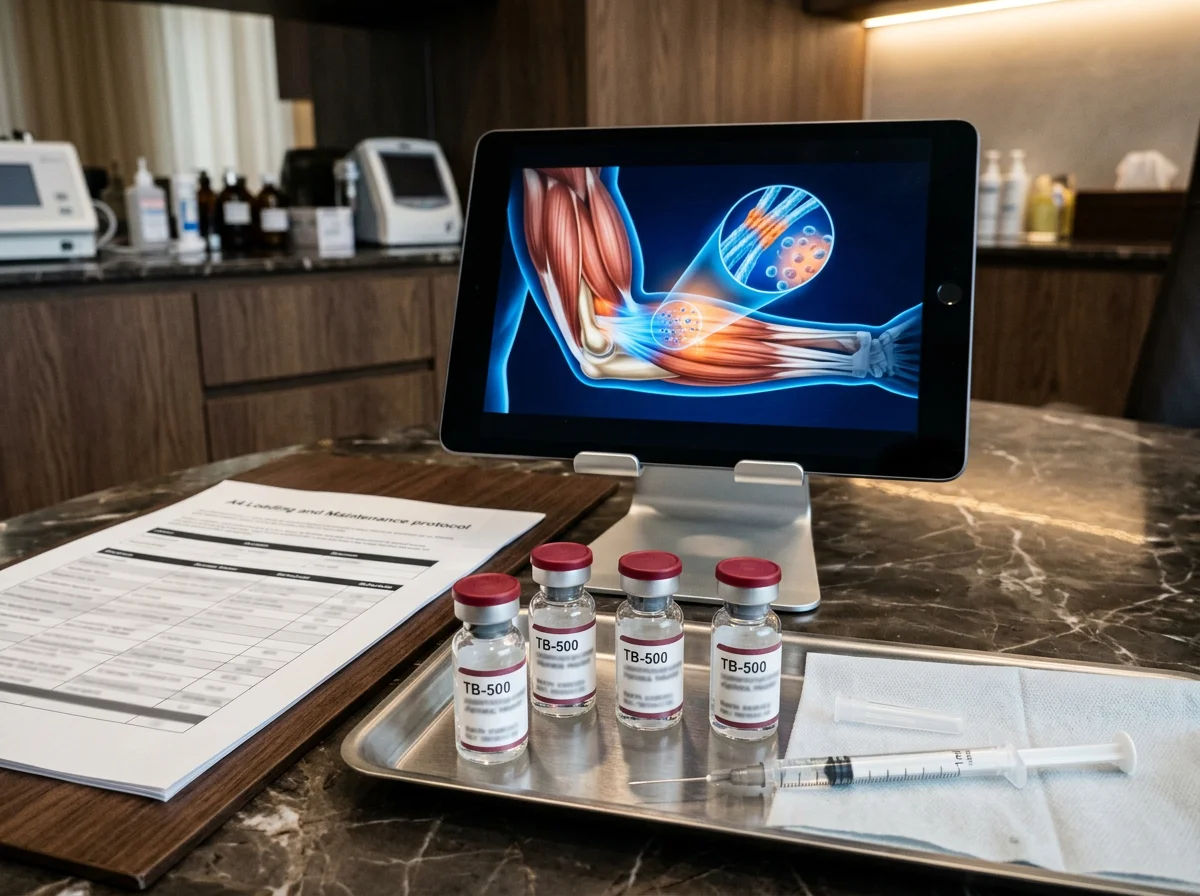
TB-500 dosage is fundamentally different from most peptides - this is not a daily microdose compound. TB-500 (Thymosin Beta-4 fragment) is dosed in milligrams, not micrograms, and uses a two-phase protocol (loading then maintenance) that most patients get wrong. The distinction between a protocol that drives genuine 30–50 % faster healing and one that barely moves the needle often comes down to whether the loading phase was completed correctly.
If you're searching for TB-500 dosage, how much TB-500 to inject, TB-500 loading phase dose, TB-500 maintenance dose, TB-500 for tendon healing, TB-500 reconstitution, or TB-500 vs BPC-157 dose, this guide covers every protocol in clinical use. The Sculptique Aesthetics offers TB-500 and peptide therapy under medical supervision in Mumbai, Bandra, Khar, Andheri, South Mumbai and across India.
This is an educational reference. Individual TB-500 dose, frequency and cycle are set at consultation - not from online protocols.
What is TB-500 and why does dose differ from other peptides?
TB-500 is a synthetic fragment of Thymosin Beta-4 (Tβ4) - a naturally occurring 43-amino-acid protein found in virtually every human tissue. The biologically active fragment (amino acids 17–23) retains most of the full protein's therapeutic effects:
- Upregulates actin - the protein essential for cell structure and movement, enabling faster cell migration to wound sites
- Promotes angiogenesis - generates new blood vessels that persist long-term, improving tissue perfusion
- Reduces inflammation - without suppressing immune function (unlike corticosteroids)
- Decreases fibrosis - limits scar tissue in favour of quality tissue regeneration
- Improves flexibility - by improving tissue quality and reducing adhesions
Why doses are in milligrams: TB-500 operates at a systemic, whole-body level - it distributes throughout the bloodstream and reaches damaged tissue everywhere, not just the injection site. Systemic distribution requires higher absolute doses than locally acting peptides like BPC-157. Injection location is essentially irrelevant for TB-500; it goes where it's needed.
See BPC-157 & TB-500 recovery guide for comparison of both peptides and how they work together.
The TB-500 two-phase protocol: loading and maintenance
TB-500 has a half-life of approximately 2–4 days, which supports twice-weekly rather than daily dosing. The two-phase approach is standard because:
- Loading phase builds up tissue saturation quickly - cells need adequate TB-500 present to initiate the full repair cascade
- Maintenance phase sustains that saturation at lower cost while healing progresses - full loading doses indefinitely aren't needed or beneficial
Skipping the loading phase by jumping straight to maintenance doses is the most common TB-500 dosing mistake - you never build adequate tissue concentrations and results are poor.
TB-500 loading phase dosage
- Standard loading dose: 2–2.5 mg per injection, twice weekly (e.g. Monday + Thursday)
- Total per week: 4–5 mg
- Aggressive loading (severe / acute injuries): 5 mg per injection, twice weekly = 10 mg/week
- Conservative loading (prevention / budget): 2.5 mg per injection, twice weekly = 5 mg/week
- Duration: 4–6 weeks
- Total peptide for standard loading: approximately 40–50 mg (standard) or 80 mg (aggressive)
TB-500 maintenance phase dosage
- Standard maintenance dose: 2–2.5 mg once weekly
- Reduced maintenance: 2 mg every 2 weeks (for long-term joint support)
- Duration: 4–8 weeks after loading; some patients continue monthly maintenance indefinitely for chronic joint or connective tissue conditions
- Total standard 12-week protocol: 40 mg loading + 20 mg maintenance = 60 mg total
TB-500 dosage quick-reference by goal
| Goal | Loading dose | Loading frequency | Maintenance dose | Total duration |
|---|---|---|---|---|
| Acute injury (severe) | 5 mg | 2× weekly × 4–6 weeks | 2.5 mg weekly | 12 weeks |
| Standard healing | 2.5 mg | 2× weekly × 4 weeks | 2 mg weekly | 10–12 weeks |
| Conservative / prevention | 2.5 mg | 2× weekly × 4 weeks | 2 mg every 2 weeks | 12+ weeks |
| Long-term joint support | 2.5 mg | 2× weekly × 4 weeks | 2 mg monthly | Indefinite |
Your individual dose is set at consultation at The Sculptique Aesthetics.
Alternative TB-500 protocols for different goals
Daily low-dose protocol
For patients who prefer more frequent, lower-volume injections:
- Dose: 750 mcg – 1 mg daily, subcutaneous
- Duration: 12 weeks continuous, then 4 weeks off
- Provides steady-state tissue levels without peaks and troughs of twice-weekly dosing
- Preferred by some patients with needle anxiety (smaller volume per injection)
Body-weight-based TB-500 dosing
Some practitioners calculate by weight for greater precision:
- Loading: 30–60 mcg/kg per injection, twice weekly
- Maintenance: 30 mcg/kg once weekly
For a 75 kg patient: loading = 2.25–4.5 mg per injection; maintenance = 2.25 mg weekly - closely matching the standard protocol.
TB-500 reconstitution: avoiding errors that ruin every dose
TB-500 vials are typically 5 mg or 10 mg lyophilised powder. Reconstitute with bacteriostatic water only.
Concentration formula: mg/ml = vial mg ÷ ml of water
| Vial size | Water added | Concentration | 2.5 mg dose | 5 mg dose |
|---|---|---|---|---|
| 5 mg | 1 ml | 5 mg/ml | 0.5 ml (50 units) | 1.0 ml (100 units) |
| 5 mg | 2 ml | 2.5 mg/ml | 1.0 ml (100 units) | 2.0 ml (200 units) - over syringe capacity; use 1 ml syringe |
| 10 mg | 2 ml | 5 mg/ml | 0.5 ml (50 units) | 1.0 ml (100 units) |
| 10 mg | 4 ml | 2.5 mg/ml | 1.0 ml (100 units) | 2.0 ml |
Important note: TB-500 injection volumes are much larger than BPC-157. You are often drawing 0.5–1 ml, not 0.1 ml. Use a standard 1 ml or 2 ml syringe - a standard insulin syringe may not hold the full dose.
Refrigerate reconstituted solution at 2–8 °C and use within 28–30 days. Never freeze after reconstitution.
Injection technique for TB-500
Route: subcutaneous (SC) injection into any fatty tissue site. Because TB-500 distributes systemically regardless of where you inject, site selection is primarily about comfort and convenience.
Common sites: abdomen, outer thigh, upper arm. Rotate sites to prevent lipoatrophy.
Why injection site doesn't matter for TB-500 (unlike BPC-157): TB-500 circulates through the bloodstream and migrates to areas of tissue damage - it seeks out injured tissue via actin upregulation signals. You do not need to inject near the injury.
Needle: 25–27 gauge, 16–25 mm for SC is standard. The larger volume (0.5–1 ml) compared to BPC-157 means you may need a slightly longer needle than the standard short insulin needle.
TB-500 and BPC-157 together: the Wolverine stack
TB-500 and BPC-157 are complementary, not redundant. They target the same outcome (tissue repair) through different mechanisms:
- BPC-157: local growth factor expression, fibroblast stimulation, angiogenesis at the injury site
- TB-500: systemic cell migration, actin regulation, reduction of chronic inflammation throughout the body
Standard Wolverine stack:
- BPC-157: 250–500 mcg SC twice daily, injected near the injury site where possible
- TB-500: 2–2.5 mg SC twice weekly loading (weeks 1–4), then 2 mg weekly maintenance (weeks 5–12)
- CRITICAL: do not mix in the same vial - they can be injected in the same session but must remain in separate solutions. Mixing risks instability and peptide degradation.
Adding GHK-Cu creates the GLOW stack - the most comprehensive tissue repair and skin/collagen protocol in clinical use. See GHK-Cu dosage guide and BPC-157 & TB-500 recovery guide.
How long does TB-500 take to work?
- First 2 weeks: reduced inflammation, improved mobility in acute injuries
- Weeks 3–4: measurable reduction in pain; improved range of motion
- Weeks 5–8: significant tissue quality improvement; scar tissue reduction begins
- Weeks 10–12: full healing potential of the protocol - this is when chronic injury patients see the most dramatic change
Do not stop after the loading phase when you "feel better." The maintenance phase is when tissue quality actually improves - stopping early means trading short-term pain relief for inferior long-term repair.
TB-500 dosing mistakes
- Skipping loading. Going straight to maintenance doses means tissue concentrations never reach therapeutic threshold.
- Underdosing during loading. Using 1 mg twice weekly instead of 2.5–5 mg puts you below the level needed for angiogenesis. Cut corners here and you just waste time.
- Mixing TB-500 and BPC-157 in the same vial. Peptide chemistry does not allow this safely. Separate vials, same session.
- Stopping when pain improves. Pain relief ≠ tissue healing. Complete the full 12-week protocol.
- Calculating injection volume like BPC-157. TB-500 volumes are 5–10× larger. Check your maths before drawing up.
- No physiotherapy. TB-500 accelerates healing; it does not replace rehabilitation, load management or corrective exercise.
Side effects and safety
TB-500 has a strong safety record in veterinary and animal research. Human use is not FDA-approved, but accumulated clinical experience is reassuring:
Common and mild
- Injection site reaction: mild redness, swelling, tenderness - resolves within hours; rotate sites
- Transient fatigue or headache in first 1–2 weeks; typically resolves
- Mild nausea - rare; usually related to rapid injection; slow the administration
Theoretical concerns
- Tumour promotion: animal studies at very high doses (far above clinical use) showed no pro-tumorigenic effects. Precautionary pause recommended for active malignancy.
- Blood pressure: mild transient effects at high doses in animal models; not clinically significant at standard doses
Who should avoid TB-500
- Active malignancy (precautionary)
- Pregnancy and breastfeeding
- Known peptide sensitivity
- Anyone unable to maintain sterile injection technique
Storage
- Lyophilised powder: freeze at -20 °C immediately on receipt; stable for years
- Reconstituted solution: refrigerate at 2–8 °C; use within 28–30 days; never refreeze
- Never store in bathrooms or anywhere with heat and humidity fluctuation
Frequently asked questions
Loading phase (weeks 1–4): 2–2.5 mg SC, twice weekly (total 4–5 mg/week). Maintenance phase (weeks 5–12): 2–2.5 mg SC, once weekly. These are the most commonly used research and clinical protocol doses.
Loading uses higher, more frequent doses (2–2.5 mg twice weekly) to rapidly build tissue saturation and initiate the healing cascade. Maintenance drops to 2 mg once weekly to sustain therapeutic tissue levels at lower cost. Skipping loading produces poor results.
Standard: 40 mg loading (weeks 1–4) + 20 mg maintenance (weeks 5–12) = 60 mg total (12 × 5 mg vials). Aggressive: 80 mg loading + 20 mg maintenance = 100 mg total.
No - TB-500 distributes systemically regardless of where you inject. Abdominal subcutaneous is the most convenient site. Unlike BPC-157, you do not need to inject near the injury.
No. They can be injected in the same session (separately drawn up, separate syringes), but never mix in the same vial. This ensures stability and potency of both peptides.
Reduced inflammation and improved mobility in 2 weeks; significant healing progress at 4–6 weeks; peak tissue quality improvement at 10–12 weeks. Do not assess results before 6 weeks.
BPC-157 is locally acting - targets injury site through growth factor and fibroblast pathways, dosed in micrograms (250–500 mcg), given twice daily. TB-500 is systemically acting - distributes throughout the body via actin regulation, dosed in milligrams (2–5 mg), given twice weekly. They complement each other perfectly in the Wolverine stack.
When administered under clinician supervision with medical-grade product, TB-500 has a strong safety record. We strongly recommend against self-sourcing unregulated product. See are peptides safe.
Yes - conservative loading at 2.5 mg twice weekly for 4 weeks followed by 2 mg monthly maintenance is used by athletes and active patients for connective tissue preservation.
Book your TB-500 consultation in Mumbai
If you're dealing with a slow-healing tendon, ligament or muscle injury, or chronic joint pain that hasn't responded to other treatments, TB-500 and the Wolverine / GLOW stack may be the most targeted intervention available.
Contact us at The Sculptique Aesthetics. We'll assess your injury, design the right loading and maintenance protocol, and run it alongside BPC-157 and, where appropriate, GHK-Cu for comprehensive tissue repair.
Serving patients across Mumbai, Bandra, Khar, Andheri, Powai, Juhu, South Mumbai and international patients travelling to India for medically supervised peptide therapy.
This article is for educational purposes only. It is not medical advice and does not replace a consultation with a qualified clinician.


