
The Sculptique Aesthetics
How Much GHK-Cu Should I Inject Daily? Complete Dosage Guide for Skin, Hair & Healing (Mumbai)
Full GHK-Cu peptide dosage guide - injectable, topical and oral protocols for skin rejuvenation, hair growth and wound healing, plus cycling, timing, side effects and safety from The Sculptique Aesthetics Mumbai.
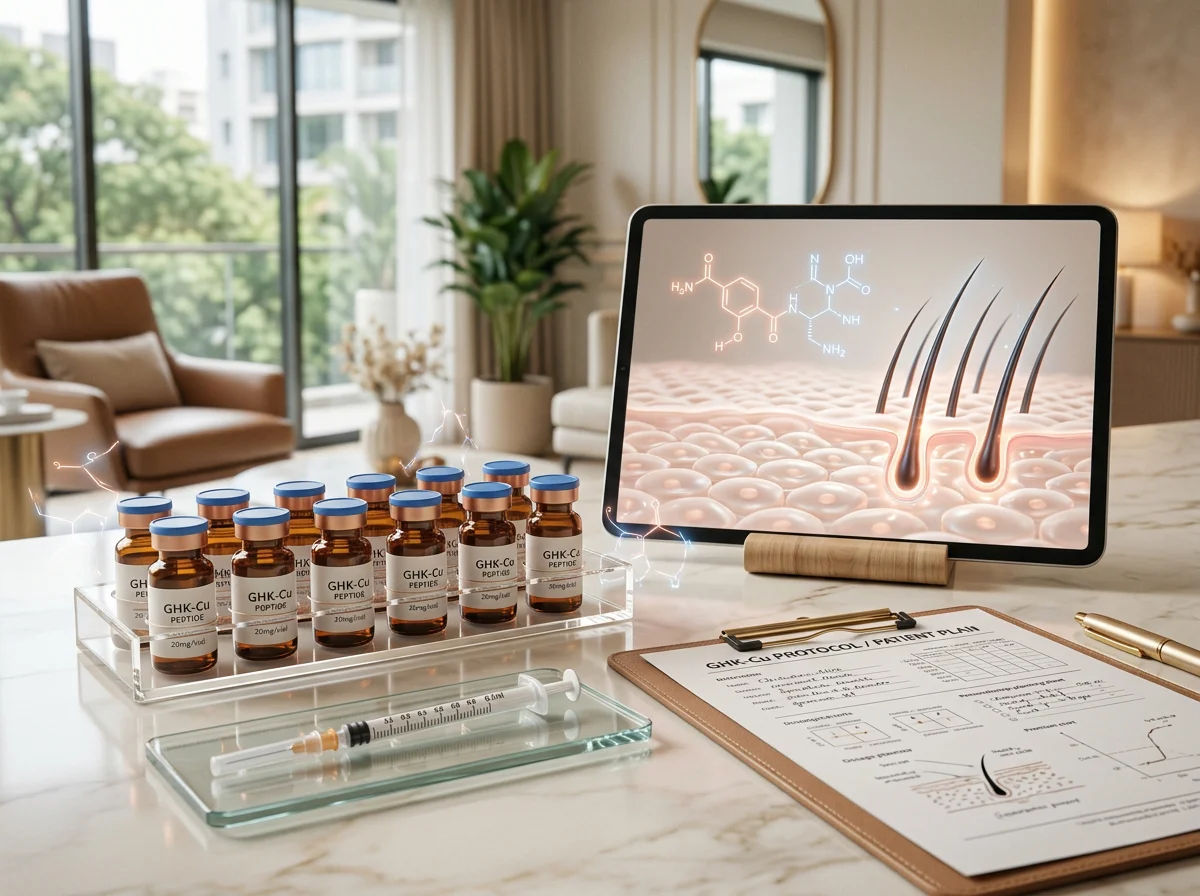
An online daily dose is not enough to justify injecting GHK-Cu. I would first ask whether there is reliable evidence for that use and what is known about the safety and quality of the product.
— Dr. Aamod Rao
The short answer: GHK-Cu dosage is individualised - most clinical and research protocols use 0.5–2 mg per day subcutaneously, but many patients do not inject every day at all. Dose, delivery method (injectable, topical, oral) and goal (skin, hair, healing) must match - get one wrong and the peptide still works, but never quite transforms. If you're searching for how much GHK-Cu should I inject daily, GHK-Cu peptide dosage, GHK-Cu dose for skin, GHK-Cu dose for hair growth, GHK-Cu for wound healing, is injecting GHK-Cu safe, what is the difference between GHK-Cu and AHK-Cu, or how long does it take to see results from GHK-Cu injections, this guide walks you through every protocol clinicians actually use - and where The Sculptique Aesthetics fits as your medically supervised GHK-Cu clinic in Mumbai, Bandra, Khar, Andheri, South Mumbai and across India.
This is an educational reference, not a self-dosing instruction sheet. We offer GHK-Cu and peptide therapy only under medical supervision, with dose, frequency and cycle individualised at consultation.
Want your GHK-Cu dose, route and cycle set correctly the first time?
Skip the guesswork and the unregulated vials. At The Sculptique Aesthetics we build your protocol around your skin, hair or recovery goals - medical-grade product, in-person reconstitution and injection coaching, and clear pricing.
Book your consultation · GHK-Cu therapy · Peptide therapy · Wellness Lounge
What is GHK-Cu and why does dose matter?
GHK-Cu (glycyl-L-histidyl-L-lysine-copper) is a naturally occurring tripeptide - three amino acids bound to a copper ion. It is small, stable and extraordinarily bioactive: published research links GHK-Cu to modulation of more than 4,000 genes affecting collagen, elastin, antioxidant defence, angiogenesis and wound repair.
GHK-Cu dosage matters because the peptide works through cellular signalling, not brute force. Too little signal and cells barely respond. Too much signal and the dose–response curve flattens - you spend more money and expose yourself to more side effects for no extra benefit. The "right" dose sits in a narrow window that depends on:
- Delivery method - injectable GHK-Cu vs topical GHK-Cu vs oral/sublingual GHK-Cu
- Goal - skin rejuvenation, hair and scalp support, wound healing, general anti-ageing
- Individual factors - age, skin type, baseline GHK levels, other peptides being stacked
Natural plasma GHK falls from roughly 200 ng/ml at age 20 to around 80 ng/ml by age 60. That decline is one reason GHK-Cu supplementation tends to produce more visible results in patients over 35–40. For a deeper primer on what peptides are and how they act, see what do peptides do, are peptides safe and are peptides steroids. For the bigger picture on where GHK-Cu fits, read our peptide therapy guide and the rising popularity of peptide therapy in India.
How much GHK-Cu should I inject daily?
Published clinical and research GHK-Cu injection dosage ranges sit between 0.5 mg and 4 mg per dose, with 1–2 mg per day being the most widely referenced starting window for adults. At The Sculptique Aesthetics we do not recommend self-dosing - our clinicians determine dose, frequency and cycle after a full consultation.
Typical injectable GHK-Cu dose ranges
- Standard starting dose: 1 mg per day subcutaneous
- Conservative / beginner dose: 0.5 mg per day
- Intensive / wound-healing dose: 2–3 mg per day
- Upper research range: 4 mg per day (rarely exceeded)
- Frequency: once daily, or split into morning + evening microdoses for steadier levels
- Route: subcutaneous (SC) injection - typically abdomen, thigh or flank; depth and angle per provider protocol
Is GHK-Cu injected daily? Not always. Many Sculptique protocols use 2–3 injections per week rather than daily, particularly for skin and maintenance goals. Wound healing and hair protocols tend to cluster closer to daily during the active phase.
GHK-Cu cycling: on/off schedules that actually work
Continuous year-round dosing is almost never needed. Cycling GHK-Cu reduces total peptide used, limits theoretical copper accumulation and often produces stronger response when you resume. Common GHK-Cu cycles:
- Standard cycle: 30 days on, 14 days off - repeat 2–3 cycles for skin goals
- Intensive cycle: 8 weeks on, 4 weeks off - preferred for hair and long healing protocols
- Maintenance cycle: 3–5 injections per week, 8 weeks on, 4 weeks off, indefinitely
A 30-on / 14-off cycle means you're only using product about 68 % of the year - meaningful savings with no loss of results in our experience.
Reconstitution and injection volume - the maths you must get right
GHK-Cu is usually supplied as a lyophilised powder that is reconstituted with bacteriostatic water before use. Errors here quietly ruin every subsequent dose.
Concentration formula: mg/ml = total mg in vial ÷ ml of water added.
Common reconstitution scenarios clinicians use:
- 50 mg vial + 2.5 ml water → 20 mg/ml - 1 mg = 0.05 ml (5 units on a U-100 insulin syringe); 2 mg = 0.10 ml (10 units)
- 50 mg vial + 2 ml water → 25 mg/ml - 1 mg = 0.04 ml (4 units); 2 mg = 0.08 ml (8 units)
- 100 mg vial + 5 ml water → 20 mg/ml - 2 mg = 0.10 ml (10 units); 3 mg = 0.15 ml (15 units)
If you are ever in doubt, bring your vial and diluent to the clinic - we will reconstitute and demonstrate correct draw-up in person. See are peptides available in India for what's realistic to source locally.
GHK-Cu topical dosage: serums, creams and scalp solutions
Topical GHK-Cu is where most patients start - especially for facial rejuvenation and early scalp support. Absorption is lower than injection, but the peptide reaches target dermal tissue directly and there's no needle.
Best GHK-Cu percentage is not "more is better". Skin has a saturation point. A well-formulated 2 % serum with the right pH, vehicle and stability can out-perform a cheap 4 % serum every single time.
GHK-Cu topical dose by indication
- Face serums / creams: 1 %–3 % GHK-Cu, applied once or twice daily (morning and/or evening); minimum 8–12 weeks for visible change
- Eye area: 1 %–2 % (lower for delicate periorbital skin); pea-sized amount once daily, usually evening
- Neck and décolletage: 2 %–3 % nightly; pairs well with sunscreen during the day
- Scalp solutions for hair: 0.5 % solution, 1–2 ml to thinning areas once or twice daily for a minimum of 6 months
- Post-procedure / post-microneedling: 2 %–4 % applied immediately after under clinician supervision
Percentage to milligrams quick conversion:
- 1 % = 10 mg per 1 ml of product
- 2 % = 20 mg per 1 ml
- 3 % = 30 mg per 1 ml
A 30 ml bottle of 2 % GHK-Cu serum therefore contains 600 mg of peptide - enough for 8–10 weeks of twice-daily use on the face.
Enhanced topical: microneedling + GHK-Cu
Rolling the scalp or face with a 0.5 mm derma roller or undergoing in-clinic microneedling before GHK-Cu application creates micro-channels that dramatically improve bioavailability. In our clinic protocols, microneedling + GHK-Cu can approach injection-level tissue concentrations for localised areas - one reason we pair it with PRF in several of our skin plans.
GHK-Cu oral and sublingual dosage
Can you take GHK-Cu orally? Yes, but classical swallowed peptides are largely destroyed by gastric acid and digestive enzymes. Two delivery tricks fix this.
- Sublingual troches / lozenges: 50–200 mcg per troche, 1–2 times daily, dissolved between cheek and gum for 15–20 minutes. Absorption happens through the oral mucosa and bypasses first-pass liver metabolism.
- Liposomal oral GHK-Cu: 100–500 mcg once daily. Lipid encapsulation shields the peptide through the stomach.
Expect oral GHK-Cu effect size to sit between topical and injectable. Oral is a reasonable option for patients who cannot or will not inject, but want systemic rather than purely local effect. Take on an empty stomach - 30 minutes before or 2 hours after food.
GHK-Cu dose by goal
Different objectives, different protocols. The same patient may run one protocol for anti-ageing and a completely different one after a surgical injury.
1. GHK-Cu dose for anti-ageing and skin rejuvenation
The most common use. GHK-Cu supports collagen synthesis, improves elasticity, reduces fine lines, and shifts gene expression toward youthful tissue.
- Injectable anti-ageing protocol: 1–2 mg daily or 5 days on / 2 off, cycle 30 days on / 14 days off, minimum 2–3 cycles for substantial change
- Topical anti-ageing protocol: 2 %–3 % serum, twice daily, minimum 12 weeks continuous use, paired with daily SPF 50 sunscreen
- Combination protocol: low-dose injectable (1 mg 3×/week) + topical 2 % serum daily - typically the most powerful approach for patients 40+
See our related pieces on anti-ageing treatments in Mumbai and how to look younger without looking fake.
2. GHK-Cu dose for hair growth and scalp health
GHK-Cu may extend the anagen (growth) phase, increase follicle size and improve scalp microcirculation. Evidence is weaker than minoxidil / finasteride, so we always use it as an add-on, not a replacement. See will GHK-Cu regrow hair for the full context.
- Injectable hair protocol: 1–2 mg daily or 5 days/week, minimum 16–24 weeks, cycle 8 weeks on / 4 weeks off
- Topical scalp protocol: 0.5 % solution, 1–2 ml twice daily to thinning areas, 6 months before meaningful assessment
- Enhanced hair protocol: GHK-Cu topical + 0.5 mm derma-roll 1–2×/week + minoxidil + finasteride (where appropriate) - the full "big-3 + peptide" stack we routinely prescribe alongside FUE hair transplant in Mumbai
3. GHK-Cu dose for wound healing and tissue repair
GHK-Cu accelerates angiogenesis, drives collagen deposition and reduces inflammation. Higher doses and shorter durations fit acute healing.
- Injectable healing protocol: 2–3 mg daily (upper end of range), systemic injection - not into the wound itself - daily until the wound resolves, plus 1–2 weeks maintenance
- Topical healing protocol: 2 %–4 % in a wound-appropriate vehicle applied 2–3 times daily to wound margins (never into an open, actively bleeding wound) under clinician supervision
- Stacking: GHK-Cu pairs exceptionally well with BPC-157 and TB-500 - the so-called GLOW stack - for complex healing cases. See our BPC-157 & TB-500 recovery guide and TB-500 dosage guide.
4. GHK-Cu dose for general wellness and longevity
For patients using GHK-Cu as a broad longevity compound, conservative dosing over extended cycles is ideal.
- Dose: 0.5–1 mg per day, subcutaneous
- Frequency: 3–5 times weekly
- Cycle: 8 weeks on / 4 weeks off, repeated indefinitely
- Stack: commonly run alongside NAD+ infusions and CJC-1295 / Ipamorelin for full anti-ageing coverage. See CJC-1295 vs Sermorelin and NAD+ IV therapy in Mumbai
GHK-Cu dosage quick-reference table (for education only)
| Goal | Best route | Typical dose | Frequency | Minimum duration |
|---|---|---|---|---|
| Anti-ageing (skin) | Topical 2–3 % ± injection 1 mg | 1 mg SC 3×/week + 2 % serum 2×/day | Daily topical, 3× weekly injection | 12 weeks |
| Deep skin rejuvenation | Injection | 1–2 mg/day SC | 5 days on / 2 off | 2 cycles of 30 days |
| Hair and scalp | Topical 0.5 % ± injection | 1–2 mg SC daily + 0.5 % topical 2×/day | Daily | 16–24 weeks |
| Wound healing | Injection | 2–3 mg/day SC | Daily | Until resolved + 2 weeks |
| Longevity / wellness | Injection | 0.5–1 mg/day SC | 3–5×/week | 8-week cycles |
| Oral / sublingual | Sublingual troche | 50–200 mcg | 1–2×/day | 12 weeks |
Ranges are from published research and clinical protocol literature. Your individual dose is set at consultation at The Sculptique Aesthetics.
Not sure which row in this table is yours? That's exactly what a consultation is for. We map your goal - skin, hair, healing or longevity - to the right route, dose and cycle, then show you how to do it safely. Book your GHK-Cu consultation in Mumbai.
What is the difference between GHK-Cu and AHK-Cu?
What is the difference between GHK-Cu and AHK-Cu dose? Both are copper peptides; only the first amino acid differs (glycine in GHK-Cu vs alanine in AHK-Cu). GHK-Cu has the larger skin and wound-healing evidence base; AHK-Cu is more often seen in hair formulations.
- GHK-Cu topical: 1 %–3 % for skin, 0.5 % for scalp
- AHK-Cu topical: 0.05 %–0.1 % is standard in most hair serums - note this is much lower than GHK-Cu percentages
- Injectable AHK-Cu: less well characterised; not part of our standard Mumbai protocols
Do not simply swap percentages between the two peptides. See what is AHK-Cu used for and is AHK-Cu a DHT blocker for a fuller comparison.
GHK-Cu stack dosing: what changes when you combine peptides?
GHK-Cu pairs logically with peptides that target complementary pathways.
- GLOW stack (healing): GHK-Cu 1–2 mg + BPC-157 250–500 mcg + TB-500 250–500 mcg per day. See BPC-157 & TB-500 recovery guide.
- Anti-ageing stack: GHK-Cu 1 mg 3×/week + CJC-1295 / Ipamorelin evenings. See CJC-1295 vs Sermorelin.
- Skin stack: GHK-Cu topical 2 % + Epithalon cycles for circadian / telomere support.
When stacking, many clinicians reduce each peptide by 25–50 % from its standalone dose because of the additive effect. We individualise this at consultation.
Is injecting GHK-Cu safe?
When performed by a trained provider using medical-grade product, correct dosing and sterile technique, GHK-Cu injections are generally well tolerated. Risk is almost always a product of self-sourcing unregulated vials, poor reconstitution, non-sterile technique, or wrong dose for goal - all of which we see in patients who come to us after online DIY protocols.
Is injecting GHK-Cu safe in pregnancy, with active cancer, or with copper metabolism disorders? No - see contraindications below. Everyone else benefits from a short clinician-led consultation before starting. See are peptides safe.
How long does it take to see results from GHK-Cu injections?
Patience is required - GHK-Cu changes gene expression, not surface chemistry.
- Injectable skin results: subtle glow at 2–3 weeks; visible fine line and texture change at 6–8 weeks; full result over 2–3 cycles (roughly 4–6 months)
- Topical skin results: 8–12 weeks minimum for visible change
- Hair / scalp: 4–6 months before honest assessment, 9–12 months for mature result
- Wound healing: noticeable acceleration within days to 2 weeks on intensive injectable protocols
Photograph yourself in consistent lighting at baseline and every 4 weeks. Slow cumulative change is almost impossible to see without reference images.
GHK-Cu dosing mistakes we see at the clinic in Mumbai
The same errors come up again and again - and every one of them is avoidable.
- Starting too high. Enthusiasts leap to 3–4 mg daily on day one. Start at 0.5–1 mg and climb only if needed.
- Confusing topical and injectable doses. 2 mg injected is not remotely the same as 2 mg rubbed on the face. Scale is defined by bioavailability, not quantity.
- Inconsistent administration. GHK-Cu compounds with consistency. Skipping days produces skipped results.
- Reconstitution errors. Sloppy water measurement means every injection for the next month is wrong.
- No SPF. Doing GHK-Cu for anti-ageing with no sunscreen is like filling a bath with the plug out.
- Ignoring the basics. Sleep, nutrition, alcohol, smoking - these will determine your result more than 1 mg vs 2 mg ever will.
- Self-sourcing unregulated product. We regularly see patients with injection-site infections and erratic dosing from product bought online. Please don't. See are peptides safe.
Already bought a vial online and unsure if it's safe to use? Bring it in. We'll assess the product, get your reconstitution and dose right, and put you on a proper protocol instead of guesswork. Talk to our team in Mumbai.
What are the side effects of copper peptides?
GHK-Cu has a strong safety profile in its standard dose ranges, but awareness matters.
Common side effects
- Injection-site reactions: mild redness, tenderness, swelling, occasional bruising - usually resolve within hours
- Skin flushing / warmth - brief, related to vasodilation
- Transient fatigue in the first 1–2 weeks of intensive protocols
- Mild headache - usually dose-related
Higher-dose theoretical concerns
- Copper accumulation - each 2 mg injection adds roughly 0.03 mg of elemental copper, trivial next to the 0.9–2.2 mg from a normal diet. Cycling further reduces any risk.
- Blood pressure: GHK can mildly lower BP at high doses. Monitor if you are hypotensive or on antihypertensives.
- Topical reactions: rare irritation, redness or dryness, especially at 3 %+ percentages on sensitive skin.
Who should avoid GHK-Cu entirely
- Wilson's disease or any copper metabolism disorder
- Active malignancy until more evidence exists
- Pregnancy and breastfeeding
- Known copper sensitivity
- Anyone unable to maintain sterile technique for injection
When unsure, talk to us before starting anything. See are peptides safe and what do peptides do.
Injection depth and technique: GHK-Cu vs other injectables
How deep do you inject GHK-Cu? GHK-Cu is typically given subcutaneously into the fat layer of the abdomen, thigh or flank using a short insulin needle. Some facial protocols use very superficial intradermal technique - that must be clinician-administered.
GHK-Cu is not hCG. hCG (human chorionic gonadotropin) is an unrelated fertility hormone; "500 units of hCG" has nothing to do with GHK-Cu dosing. If you have seen those two mixed up on forums, the source is unreliable.
Storage by form - does it affect your effective dose?
A poorly stored vial is an under-dosed vial. Degraded GHK-Cu = less active peptide than the label suggests.
- Lyophilised powder: freeze at -20 °C or below immediately on receipt - stable for years
- Reconstituted solution: refrigerate at 2–8 °C, use within 30 days, never freeze (ice crystals damage the peptide)
- Topical serums / creams: cool, dark storage; refrigeration extends shelf life even when not strictly required
- Sublingual troches: room temperature, original packaging, away from heat and humidity
Frequently asked questions
Dosing is individualised. Most clinical and research GHK-Cu protocols sit at 0.5–2 mg per day subcutaneously, and many patients do not inject every day - 2–3 injections per week is common for skin and maintenance goals. Wound healing often uses the upper end (2–3 mg/day). We set your exact dose and frequency at consultation - please do not self-dose.
Start conservative. 0.5–1 mg subcutaneous daily, or a 1 %–2 % topical serum applied once daily, is the usual beginner GHK-Cu dosage. Lower starting doses reveal how your skin and body respond before you commit to higher amounts.
1–2 mg subcutaneous daily, or 1 mg three times weekly, is the most commonly used GHK-Cu skin dose in published research and clinic practice. Many patients do extremely well on the lower end when paired with a topical 2 %–3 % serum and good sun protection.
Injectable: 1–2 mg daily for 16–24 weeks minimum. Topical scalp: 0.5 % solution, 1–2 ml twice daily for at least 6 months. GHK-Cu is an add-on, not a replacement for minoxidil and finasteride.
No, not on a milligram-for-milligram basis. Injectable GHK-Cu reaches tissue concentrations roughly 10–20 times higher than equivalent topical application. However, a well-formulated 2 %–3 % topical serum applied consistently over 12+ weeks produces excellent facial results without the needle. For systemic benefit, injection wins.
Published research protocols rarely exceed 4 mg per day injected. Most long-term protocols settle at 1–2 mg per day because the dose–response curve plateaus. Higher does not equal better - it equals more expensive and more side-effect prone.
Not recommended. GHK-Cu cycling - typically 30 days on / 14 off or 8 weeks on / 4 off - produces comparable results, reduces cost, limits theoretical copper load and keeps receptor sensitivity fresh.
2 % is the sweet spot for most patients. 1 % works well for sensitive or beginner skin. 3 % can be used for mature or sun-damaged skin under clinician guidance. Beyond 3 %–4 % you usually pay for concentration you cannot absorb.
When performed by a trained provider with medical-grade product, correct dosing and sterile technique, GHK-Cu injections are generally safe and well tolerated. We do not recommend self-injection or unregulated product.
Both are copper peptides; the first amino acid differs. GHK-Cu has more skin and wound healing research; AHK-Cu is more often in hair serums at much lower percentages (0.05 %–0.1 %). They are not interchangeable dose-for-dose.
For skin, GHK-Cu has solid evidence for collagen and repair. For hair, it is a reasonable add-on but not a first-line treatment. We set realistic expectations and tailor use to your goals.
Topical: mild irritation, redness or dryness. Injectable: tenderness, swelling, bruising at the site, occasional mild flushing or transient fatigue. Rare reactions are possible - we discuss everything before starting.
Subtle changes at 2–3 weeks; visible improvement in texture, tone and fine lines at 6–8 weeks; full result over 2–3 cycles (roughly 4–6 months). Hair changes need 4–6 months minimum.
Collagen synthesis, antioxidant activity, tissue repair, angiogenesis, improved skin tone and elasticity, and - as an add-on - scalp and follicle support.
Yes - this is the GLOW stack commonly used for injury and post-surgical healing. Typical doses: GHK-Cu 1–2 mg + BPC-157 250–500 mcg + TB-500 250–500 mcg per day during the active phase. See BPC-157 & TB-500 recovery guide.
Continue with your next scheduled dose - do not double up. Single missed doses have minimal impact. Pattern matters far more than perfection.
Usually no - GHK-Cu protocols use fixed doses rather than mg/kg calculations. Extremes matter: patients under 50 kg often do well at the lower end, patients over 100 kg may sit at the upper end of standard ranges.
We strongly recommend against self-sourcing and self-dosing GHK-Cu. Risks include unregulated product quality, reconstitution errors, injection-site infection and inappropriate dose or cycle for your goal. At The Sculptique Aesthetics, dose, technique and cycle are set by a clinician and product is medical-grade.
No. hCG is a hormone (human chorionic gonadotropin); GHK-Cu is a copper peptide. Dosing units for hCG do not apply to GHK-Cu.
Building your personalised GHK-Cu protocol in Mumbai
A workable GHK-Cu protocol comes from six clean steps:
- Define the goal - skin, hair, healing, longevity or a combination
- Choose the route - injectable, topical, oral, or a combination
- Set the starting dose - conservative end of the range for your goal
- Set the schedule - daily, 5-on/2-off, or 3×/week; lock the timing
- Document baseline - standardised photos and symptom notes
- Review at 4 weeks - adjust dose only after honest assessment
We do exactly this at The Sculptique Aesthetics for every GHK-Cu, peptide therapy and IV drip plan.
Book your GHK-Cu consultation in Mumbai
If you've read this far, you already know more about how much GHK-Cu to inject daily and GHK-Cu peptide dosage than most people running protocols off Reddit. The next step is turning that knowledge into a plan built around your skin, your hair, your recovery goals - and dosed accurately.
Contact us at The Sculptique Aesthetics and we'll sit down, map your goals to the right injectable, topical or combined GHK-Cu protocol, explain realistic timelines and costs, and - critically - tell you if GHK-Cu is not the right answer and something else (like minoxidil + finasteride + FUE hair transplant, a proper PRP / PRF plan, or an IV drip stack) is a better fit.
Serving patients across Mumbai, Bandra, Khar, Andheri, Powai, Juhu, South Mumbai and international patients travelling to India for medically supervised peptide therapy.
This article is for educational purposes only. It is not medical advice and does not replace a consultation with a qualified clinician.


