
The Sculptique Aesthetics
Bacteriostatic Water and Peptides: Water Changes Concentration, Not the Amount
Adding more water to a peptide vial does not add peptide. It dilutes it. Bacteriostatic water contains benzyl alcohol to limit bacterial growth, and it is not the right diluent for every product.
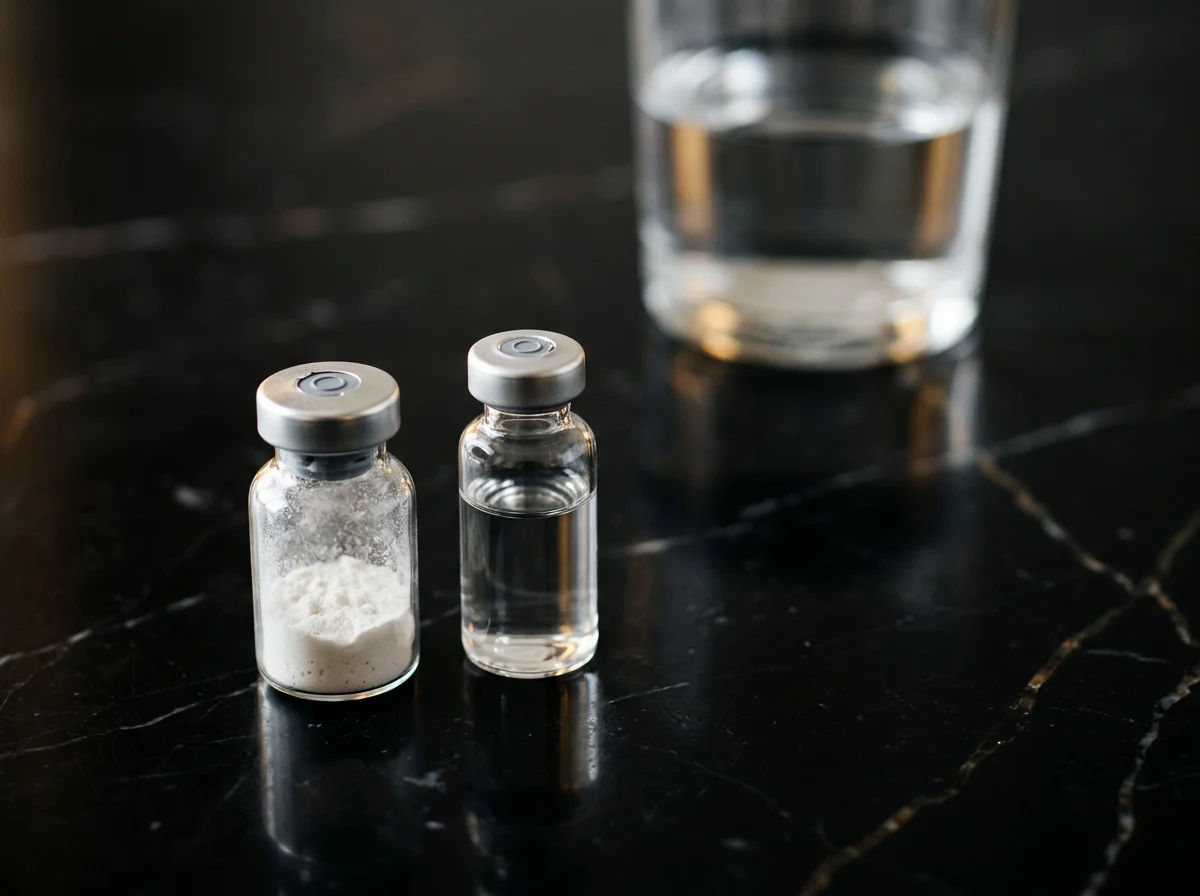
Patients tell me they added extra water "to make it safer." The vial still holds the same milligrams. What changed is how many milligrams are in each drop, and whether that diluent was even the one that product allows.
— Dr. Aamod Rao
When you open many peptide vials you see a small white plug at the bottom. That is usually a freeze-dried powder with a measured amount of peptide in it. The powder is the dose inventory. The water you add afterwards decides how concentrated the liquid is. It does not decide how much peptide you bought.
The sugar analogy, with the arithmetic
Dissolve one spoon of sugar in a small glass of water. Dissolve the same spoon in a jug. Every sip from the jug is less sweet. You did not create more sugar by adding water, and you did not destroy it. You spread it out.
Peptides follow the same rule.
| Peptide in the vial | Water added | Concentration | Peptide still in the vial |
|---|---|---|---|
| 10 mg | 1 ml | 10 mg/ml | 10 mg |
| 10 mg | 2 ml | 5 mg/ml | 10 mg |
| 10 mg | 3 ml | about 3.3 mg/ml | 10 mg |
The formula is the whole story: concentration in mg/ml equals milligrams in the vial divided by millilitres of diluent. More water, lower concentration. Less water, higher concentration. The label on the powder does not increase because the syringe looks fuller.
This is why two people can "take 10 units" from vials that were mixed differently and receive very different amounts of peptide. The insulin syringe is measuring volume. It is not measuring milligrams unless someone has already done this division. This article does not set a dose. A dose is a clinician's decision for a specific product and a specific person. If you are unsure what your vial contains, bring the vial and the diluent to the clinic rather than guessing units off a forum.
Why bacteriostatic water exists
Bacteriostatic water for injection is sterile water with a preservative, benzyl alcohol, most commonly at 0.9 percent (9 mg in each millilitre). The preservative is there to limit bacterial growth when a vial is punctured more than once.
That is a narrower job than the internet gives it.
The preservative does not make an injection safe if the powder was never a medicine, if the vial was contaminated before you opened it, or if the needle technique is poor. It does not sterilise a peptide. It does not extend the life of every mixed solution to a convenient month. Many multi-dose diluent vials are treated, in ordinary pharmacy practice, as having a limited life after the first puncture. The peptide solution you have just made can have a shorter life than the diluent did. Follow the instructions for that product, keep mixed vials as those instructions say (often refrigerated, protected from light), and discard anything cloudy, discoloured or past the date you were given.
Benzyl alcohol has a known toxicity in newborns, the gasping syndrome reported when it was used in their fluids. Bacteriostatic water is not an infant product. Our patients are adults, and the point still belongs in any honest description of the preservative.
Not every peptide wants this diluent
Some products are meant to be mixed with bacteriostatic water. Some specify sterile water for a single use, with no preservative, because the solution will be used at once. Some specify a different diluent entirely. Benzyl alcohol is not a neutral passenger for every sequence.
"More water" is also not a safety strategy. A larger injection volume can hurt more. A weaker concentration can tempt someone to draw a large volume to chase a milligram figure they found online. Neither choice creates a safer injection. The correct diluent, the correct concentration and the storage conditions are properties of that medicine's instructions.
Plain sterile water without a preservative is a poor plan for a vial you intend to puncture all week. The absence of benzyl alcohol means you have removed the thing that was limiting bacteria, and you have not gained peptide.
What to do with a vial you already mixed
Read the label for the amount of peptide, not the volume of water. Do the division above before you talk about "units." If the label is missing, if the powder was sold as a research chemical, or if you do not know which diluent went in, stop. A clinic cannot reverse-engineer an unknown vial into a safe dose.
We reconstitute and teach injection technique in person for the peptides we actually use, including GHK-Cu, BPC-157 and TB-500, after a consultation. How those names differ from nickname blends is covered in the Wolverine blend and the GLOW blend. Sourcing is covered in are peptides available in India.
Frequently asked questions
No. The milligrams stay the milligrams on the label. Extra water lowers the concentration, so each millilitre contains less.
Because benzyl alcohol, usually at 0.9 percent, helps limit bacterial growth in a vial that will be punctured more than once. It is a preservative. It is not a dose, and it is not a sterilising step you can apply to any powder.
No. Safety depends on the right product, the right diluent, the right concentration, storage and technique. Adding water changes concentration only.
No. Peptide injections are not kitchen chemistry. Drinking water, even boiled, is not sterile water for injection and has no preservative standard for this use.
Do not inject it to "use it up." Bring the vial, the diluent bottle and whatever instructions you were given to a consultation. If we cannot identify what is in it, the correct act is to discard it.
Bring the vial
If you want the concentration checked and the injection taught properly, book a visit with the unopened products. We would rather do the arithmetic with you once than hear the unit count from a comment thread.
Book a consultation · Peptide therapy
Sources
Checked 18 November 2026:
- Bacteriostatic water for injection is sterile water containing benzyl alcohol, commonly 0.9 percent (9 mg/ml), used as a preservative in multi-dose vials. Confirm the label of the specific product in your hand. US labels describe this composition; they are not an instruction to mix research peptides at home.
- Benzyl alcohol toxicity in newborns (gasping syndrome) is the reason these diluents are not used in neonates. Adult aesthetic use still requires the diluent specified for that medicine.
- Concentration identity used in clinic teaching: mg/ml = milligrams of peptide ÷ millilitres of diluent. Volume on an insulin syringe is not a milligram measurement until that division is done.
This article is for educational purposes only. It is not medical advice and does not replace a consultation with a qualified clinician.


